Most people think about health in terms of weight.
- Lose a few pounds.
- Fit into better clothes.
- Look better in the mirror.
But what if that entire framework is missing the real target?
Because when we step back and look at long-term health, performance, and aging… the conversation shifts.
It’s not just about weight.
It’s about muscle.
The Silent Problem: Losing Muscle Without Realizing It
There’s something happening to almost everyone starting in their 30s—and most people have no idea it’s even occurring.
It’s called sarcopenia: the gradual loss of muscle mass over time.
And here’s the issue:
You can be losing muscle… while your weight stays the same—or even increases.
That means:
- Your metabolism slows
- Your strength declines
- Your risk for injury increases
- Your ability to maintain independence later in life decreases
All while the scale may not even move.
This is why focusing only on weight loss is incomplete.

Muscle Is Metabolic Currency
Think of muscle as one of the most important organs in your body—because metabolically, it is.
Muscle tissue:
- Helps regulate blood sugar
- Improves insulin sensitivity
- Increases resting metabolic rate
- Supports hormone balance
- Protects against chronic disease
When you lose muscle, your body becomes less efficient.
When you build muscle, your body becomes more resilient.
That’s a completely different conversation than just “burning calories.”
Why Cardio Alone Isn’t Enough
A lot of people default to cardio.
Walking, running, cycling—it’s all great for cardiovascular health.
But here’s the reality:
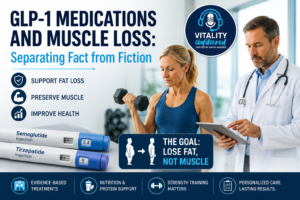
Cardio does very little to preserve or build muscle.
In fact, in some cases—especially when combined with calorie restriction—it can accelerate muscle loss.
That’s where strength training changes everything.
Strength Training: The Missing Piece
Strength training isn’t just about lifting heavy weights or building a certain physique.
It’s about sending a signal to your body:
“This muscle is important. Keep it.”
And when you consistently apply that signal, your body adapts:
- Muscle mass increases
- Bone density improves
- Joint stability gets better
- Metabolic function improves
This is why strength training is one of the most powerful tools we have for longevity medicine.
Strength Training and Aging: The Real Advantage
If you want to understand the long-term impact, think about this:
The difference between someone who ages well and someone who struggles often comes down to strength and muscle preservation.
Strength training has been associated with:
- Lower risk of falls and fractures
- Better mobility and independence
- Improved cognitive health
- Reduced risk of metabolic disease
This isn’t about aesthetics.
This is about maintaining your quality of life.
How to Start (Without Overcomplicating It)
You don’t need a complicated plan.
You need consistency.
A simple starting point:
- 2–3 days per week
- Focus on major movement patterns (push, pull, squat, hinge)
- Use resistance that challenges you safely
- Progress gradually over time
Even small improvements in strength can create meaningful changes in health.
The Bigger Picture: It’s Not Just Fitness—It’s Strategy
At Vitality Unfiltered, we talk a lot about precision medicine and longevity.
Strength training fits directly into that model.
Because it’s not just exercise—it’s a biological intervention.
It influences:
- Hormones
- Metabolism
- Inflammation
- Aging pathways
When combined with proper nutrition, hormone optimization (when appropriate), and a structured plan…
It becomes one of the most powerful tools you have.

Final Takeaway
If you’re only focused on losing weight, you’re missing the bigger opportunity.
Because the goal isn’t just to be lighter.
The goal is to be:
- Stronger
- More resilient
- Metabolically healthier
- And better prepared for the decades ahead
Want to Go Deeper?
If you want a more detailed breakdown of the science behind strength training and how it fits into a comprehensive medical approach, check out the original article here:
https://www.weightlossandvitality.com/blog/importance-of-strength-training